
Specifications and supply
The price per light point describes the first day and says nothing about the others. What matters is settled by three questions, and they are asked early.
The purchase price is the only line anyone knows
About a lighting installation exactly one thing is known precisely: what it costs to buy. Everything else — energy, maintenance, replacements, the hours a room stands idle — arrives later, spread over years, and almost never lands on the sheet where the decision was made.
So two offers get compared on a number that describes the first day. Nobody is being clever: it is simply how quotations are built. But it means the heaviest line of a contract installation, namely its maintainability, appears nowhere at the moment of signing.
A sealed fitting is not a cheap fitting
Many decorative fittings are born closed. The source is glued to the body, the driver is potted in resin, and there is no intended way in. That is not a construction flaw: it is a choice that lowers the price and simplifies production, and on a domestic fitting it is often perfectly fine.
In a hotel or a restaurant that same choice changes nature. When the source fails, the only possible action is replacing the whole body. While the model stays in the catalogue the damage is contained; the day it leaves production, the room loses the evenness it had, and nobody had budgeted for that.
The question a client rarely asks
There is a question that belongs in every specification and is mostly heard after the failure: in six years, who gives me the part? Not «a spare exists», which is a sales answer, but who manufactures it and under what commitment.
The difference between the two questions lies entirely in the chain. A reseller answers for whatever its own supplier keeps producing, and does not decide. A manufacturer answers for itself, and can commit even to a single piece. Those are promises of different weight, and they have to be written differently.
It opens, or it does not
Repairability is not read on a datasheet: it is seen with the fitting in hand. Four signs are recognisable in half a minute, and they are worth more than any declaration.

These are checks anyone can run on the sample, before the supply. If there is no sample, that is already an answer.
- screws instead of glue, where the source enters the body
- driver reachable without dismantling the load-bearing structure
- source on a standard holder, or at least on a declared module
- finish that can be touched up on site, instead of going back to the workshop
Evenness is the risk that shows up first
A fitting replaced with a similar but not identical model is noticed at once when it stands in a row with the others. No technical eye is needed: you see it walking down a corridor. It is the defect a client finds first, and the one that speaks worst of the supply.
That is why continuity of the model weighs more than its absolute quality. A modest fitting that stays available for ten years protects the room better than an excellent fitting that disappears from the catalogue in two.
What a replacement really costs
The cost of a replacement is not the price of the part. It is the part plus the work, plus the time that part of the building is not working. In a lobby it happens at night; in a meeting room it happens when the room is free; in a bedroom it happens by losing the bedroom.
Put that way, the line changes weight. A fitting that costs twenty per cent less and forces a room out of service for half a day at every failure is not a saving: it is a loan repaid in instalments.
Stock is a contract, not a cupboard
The commonest answer to the spares problem is stock: buy extra pieces and set them aside. It works, but only if somebody writes down how many they are, where they sit and who manages them when management changes or the maintenance contract moves to somebody else.
Stock without a document is a cupboard nobody opens. After three years, often, it is a cupboard nobody can find.
The driver ages before the source
In practice the component that fails first is almost never the LED. It is the driver, and its capacitors in particular, which work worse where it is hot. A fitting recessed into a closed ceiling void sits at a temperature no datasheet describes.

That changes what is worth asking for. An accessible, replaceable driver is worth more than ten years of declared source life, because that life is measured in conditions a building site hardly ever reproduces.
What to write in the specification, concretely
The useful clauses are few and short. No formulas are needed: what is needed is that the commitment carries a number and a name.
- the years of spare availability, declared in writing
- the maximum lead time for a single piece, not for the batch
- the colour tolerance allowed between a spare and the original
- who answers if the model leaves production before that deadline
The difference between reselling and producing
A reseller has a price advantage and a duration disadvantage: it does not decide what stays in production. A manufacturer has the opposite advantage, and in an installation meant to last that is the one that counts.
It is not a question of company size. It is a question of where the drawing sits: if the drawing is in house, the piece gets remade. If the drawing belongs to somebody else, the piece exists as long as they want it to.
When repairability is not worth it
There are cases where insisting on repairability is wrong. A technical fitting worth a few euros, installed in fifty units in a warehouse, is simply replaced: opening it costs more than it is worth.
The practical rule looks at two things together: how visible the fitting is and how expensive it is to stop it. Where both are high — lobbies, function rooms, restaurants, bedrooms — repairability pays for itself. Where both are low, it is a pointless luxury.
How to measure it, without trusting words
The most honest way to test a spares promise is to try it before signing. Ask for one single piece, in the project finish, and watch how long it takes to arrive.
A supplier who delivers a single piece in reasonable time will do it in three years too, because it means production is built to do it. One who takes two months for a sample will not improve when the piece is genuinely needed.

The ten-year account, line by line
Lined up, the items that decide the cost of an installation do not behave alike. Some are known at quotation, others only in the field, and one — the room out of service — is chosen by the calendar and not by the budget.
What changes for the operator
For a management team repairability is a continuity line, not a maintenance line. It means being able to redo a bedroom without it showing that it was redone later, and replacing a broken fitting in a lobby without opening a discussion about colour.
And it is also the only part of light a guest notices unaided. They name neither lumens nor kelvin, but they notice that one bedroom differs from another, and sometimes they write it down.
Warranty and spares are not the same promise
The two words often travel together, but they say different things. A warranty covers a defect: something that was already wrong at delivery and showed up later. A spare covers wear: something that worked for years and then stopped, as is perfectly normal.
A specification asking for five years of warranty and silent on spares has covered the rare case and left the certain one open. A warranty expires once; the need for a part returns every time a room keeps working.
Who keeps the register of fittings
In a building that runs well there is a sheet, often a dull one, saying which fitting sits in which room, in which finish and with which source. Where that sheet does not exist, every replacement starts with a survey, and the survey is done by somebody who was not there when it was installed.
It is the easiest thing to prepare and the easiest to forget. Ask for it as part of the supply rather than building it afterwards: whoever installed the fittings already holds that information, and handing it over costs an afternoon instead of two days on ladders.
How the difference shows, three years on
The simplest way to tell whether a supply was well made is to return to the same lobby after three years and look at it in the evening, when artificial light is the only light. If the row of fittings is still a row, the choice was right; if two or three pieces jar, the choice revealed itself late.
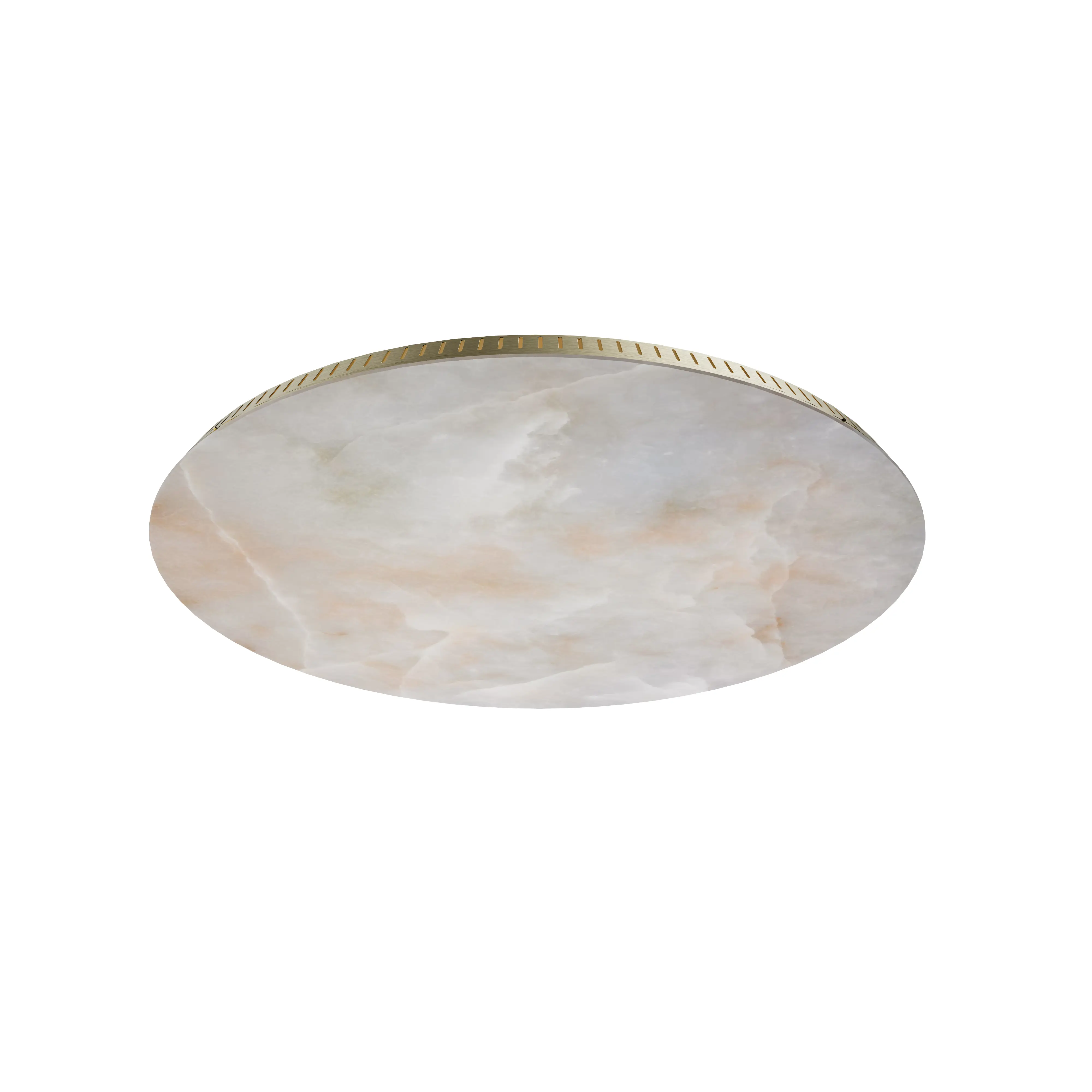
None of those pieces is broken. They simply arrived at different moments, from different batches, and nobody had written that they had to match. Repairability serves that purpose before it serves saving money: keeping identical a thing the public looks at every day.
The three lines to bring to the first meeting
If only one thing survives from all this, let it be three questions to ask a supplier before looking at the price. They are short, and the answers are understood immediately.
- the fitting opens, and with which tools
- who manufactures the spare, and for how many years they commit
- what happens to colour if the piece arrives in three years
| The line | When it becomes known | Who decides it |
|---|---|---|
| Purchase price | at quotation | the market |
| Energy | beforehand, with a calculation | the design |
| Routine maintenance | later, in the field | access to the fitting |
| Replacing a body | when the model leaves the catalogue | the supplier |
| Colour drift | at the first mismatched row | the written tolerance |
| Room out of service | whenever it happens | the calendar |
Opening it is half the job
A body that opens with screws is repaired on site. A glued one goes back to the workshop, and meanwhile the row stays mismatched.
The part exists if somebody remakes it
With a reseller the answer depends on the supplier upstream. With a manufacturer it depends on them, and it can hold for a single piece.
Colour is the part people notice
A piece replaced in three years has to come back the same. Tolerance is asked for early, because afterwards the comparison is already in the row.
We make the fittings ourselves
Shape, material, finish and source are settled in production: the spare exists because somebody remakes it. In six years too, and for one piece.