
Spaces out of scale
When a space is out of scale the problem is not power. It is proportion: hung at seventeen metres, a pendant of ordinary size becomes a dot.
Past a certain size, the catalogue ends
In a very tall atrium standard lighting is not small: it disappears. And the answer is not to buy a bigger one, because past a certain size the catalogue simply ends — not through any laziness of the manufacturers, but because a fitting of those dimensions stops being a product and becomes a structure, with a weight, a load path and a way of being installed that have to be designed together with the building.
It is a threshold that a specifier meets only a few times in a career, and every time it looks the same: the largest data sheet available is still too small, and from there on there is no catalogue, there is a project.
Two hundred and fifty-seven metres, and an atrium seventeen high
The Messeturm in Frankfurt is a Helmut Jahn tower of 1990, two hundred and fifty-seven metres tall, for years the tallest in the European Union. Its atrium measures twelve hundred square metres and rises seventeen metres, with curved glass fronts; the interiors were remade by Matteo Thun & Partners.
In a context like that we were asked to make not fittings but sculptures of light: structures able to command a space with very high ceilings visually, and fine finishes that hold their refinement at monumental scale. We did not only supply light: we made the focal point of the interior architecture.
The shape is not a taste: it follows from the plan
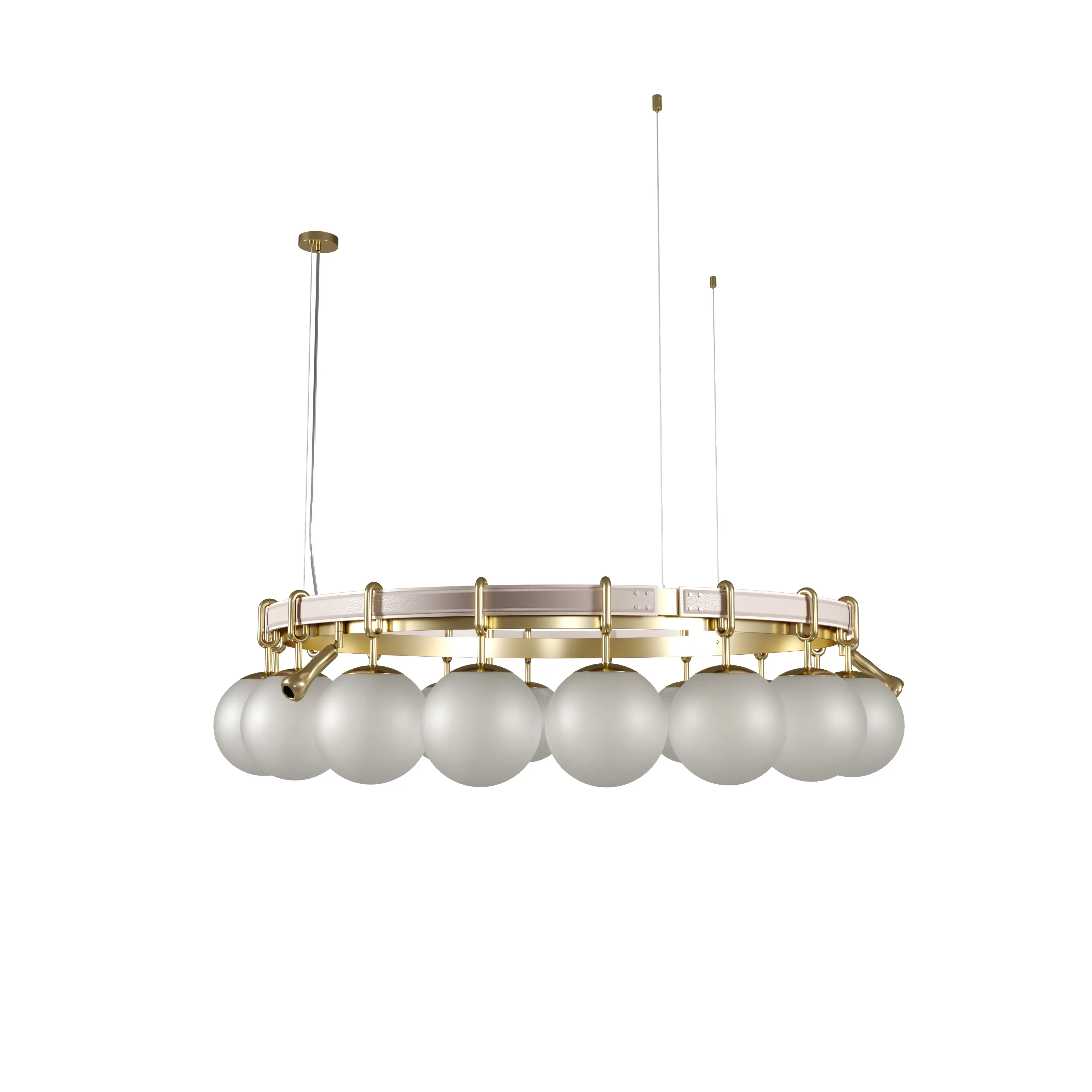
The Messeturm atrium has a long plan. A circular chandelier in there would have done two kinds of damage at once: it would have left two ends in the dark, and it would have looked small from every point — because a circle in a long plan is measured against the long side, and always loses.
The elongated ring, instead, follows the plan. It is the same reason a rectangular room gets a linear pendant rather than a round chandelier, taken to a scale at which the mistake cannot be corrected with a second fitting.
The same object changes with where you stand
There is an effect that matters more than any other in tall spaces: the view changes with the level. From below the ring reads as a continuous line; from the galleries, looking down, it reads as a closed figure. It is the same object saying two different things to two people inside the same building.
In an atrium seventeen metres high that is not a poetic detail: it is the design criterion. A fitting that works from one level only is a fitting half the people will see wrongly, and in an office lobby people are at every level at once.
An oval that size is not bought: it is bent
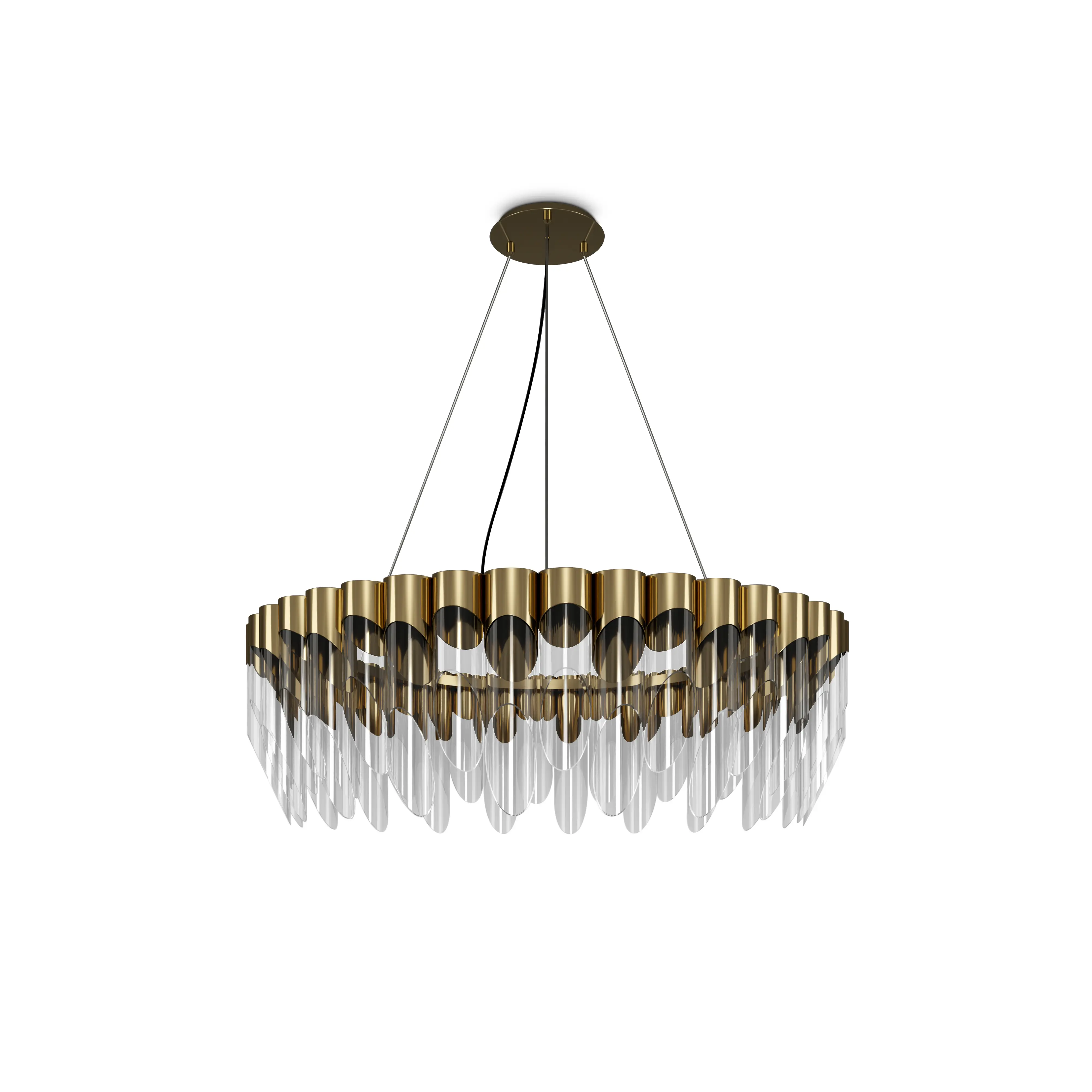
The frame is a brass profile as long as the whole fitting, and the two ends are curved. No stock piece exists with that radius: the profile is bent and reworked in the workshop until the joint can no longer be felt with a finger. The criterion is not visual but tactile, because at that distance the eye forgives and the hand does not — and during installation hands do pass over it.
It is also why pieces like this have timings that do not resemble a normal supply: between the approved drawing and the shipment there is work that cannot be compressed by placing more orders.
The flutes must stay parallel even where the glass curves
The same holds for the fluted glass. The flutes have to stay parallel even where the glass curves, or the end shows a fan instead of a surface — and a fan, on a long piece, reads across the whole hall as a fault even to somebody who could not name it.
That is why on a curved piece the glass is not simply ordered to size: it is ordered, tried on the actual end piece, and looked at against the light before being accepted.
The finish is settled on a physical sample
The brass finish is decided on a physical sample before production starts, not on a colour code written into the order. Two batches out of different baths show from ten metres, and on a fitting as long as a room there is necessarily more than one batch.

The approved sample then stays in the workshop for the whole job: it is the tool against which every finished piece is compared, and it is also the only reference that will still mean anything in a few years, if an addition is needed.
Who carries the weight, and who knows first
A fitting that becomes a structure brings a problem the catalogue never has: the slab has to know beforehand. Here the suspension is on three cables, and three cables are not a weight but three points, whose relative position matters as much as the total.
The moment this information is needed is far earlier than the moment it exists. It is the asymmetry of every bespoke piece, and it is resolved one way only: by declaring a weight ceiling and a point layout in the quotation, and designing to respect them. A figure declared with a margin is worth more than an exact figure that arrives late.
And there is a question almost nobody asks that is worth a meeting: who verifies the declared ceiling before shipping? A weight written in a quotation is a commitment; a weight actually measured before departure and put on the delivery note is proof. Between the two lies the difference between a technical discussion and a crew standing idle on site with the lifting equipment already paid for.
An atrium is lit twice a day
An atrium with glass fronts changes completely between ten in the morning and six in the evening, and a fitting that commands it has to hold both conditions. By day it competes with daylight and counts as form; at night it is the only source at the large scale and counts as light.
They are two trades, and almost always only the second gets designed. Looking at the object switched off, at eleven in the morning, from the level whoever enters will see it from, is a test that costs a morning and changes the proportions more than any calculation.
Maintenance at seventeen metres is a phase, not a call-out
A fitting that cannot be reached is a fitting that stays as it is after the first source fails. In an atrium of that height there is no ladder: equipment is needed, and equipment comes in when the hall is empty — that is, in windows decided by others.
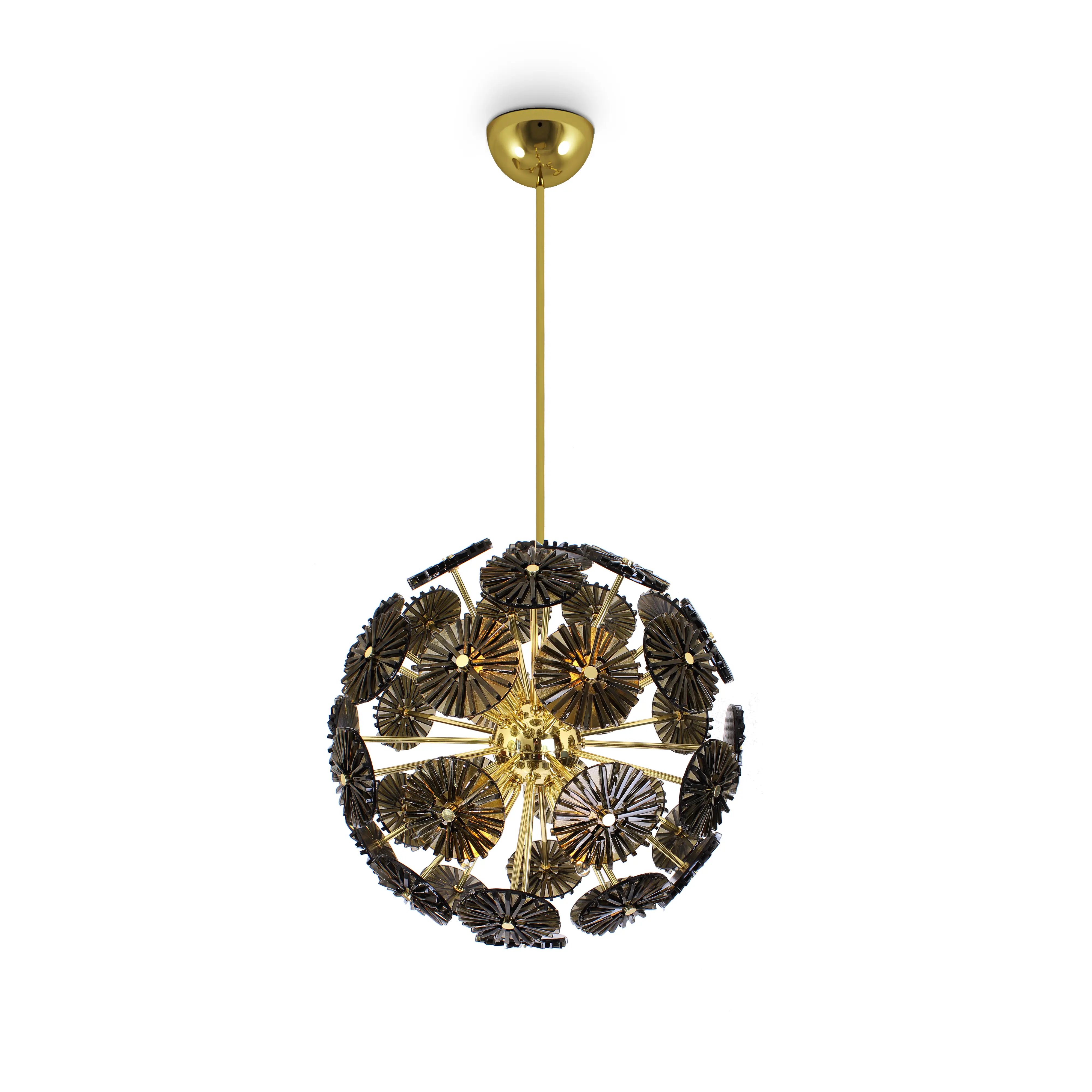
So "how is it reached" is a design question and not an operating one, and the answer changes the drawing: a ring that lowers, one reached from a gallery and one you can only get to with a platform are three different fittings even if they share a shape.
A render settles proportion, it does not promise an effect
On pieces at this scale a render is useful, and useful early: it is the only way to show whoever decides how much room the object will really take in that space. What a render does not do is show how that finish reacts to that source.
The distinction has to be said out loud, because a convincing image closes questions. On this page the ambient rendering is declared as such, and the real photographs are the workshop ones and the tower: an honesty that costs a few images and saves an argument.
Why a piece like this is made in a workshop, not a factory
Bending a brass profile as long as the fitting, and reworking it until the joint cannot be felt with a finger, is not work you programme on a machine: it is work that is judged, and the judgement is in the hand doing it.
One consequence matters to whoever orders: the time for such a piece does not scale with people. Adding two workers does not halve the bending, and asking to shorten that phase almost always means asking for a joint you can feel.
What is delivered with the piece
On a fitting that is a structure, the supply does not end with the object. You need the suspension point layout with the declared weight, the shop drawing kept with the code, the finish sample, and the assembly sequence with the equipment it needs.
Four documents, and they are the ones that keep the piece maintainable and reproducible in five years. Without them the fitting stays beautiful and becomes unrepeatable — which on a public building is a bigger problem than it looks on opening day.
What to ask when the space is out of scale
A fitting that becomes a structure brings questions that are never asked of a catalogue piece. They belong to the quotation stage, when the answer changes the drawing and not the ceiling:
- the weight and the suspension points — here three cables, and the slab has to know beforehand
- how it is reached for maintenance, and with what equipment
- whether the shape follows the plan of the space or the geometry of the fitting
- how it reads from the intermediate levels, not only from the floor
- who keeps the finish sample, and for how long
| The question | Catalogue fitting | Fitting that is a structure |
|---|---|---|
| Who decides the weight | the data sheet | the design, before the drawing |
| Suspension points | one, standard | more than one, with declared spacing |
| How it is reached | a ladder | equipment, within a site window |
| Time from order to delivery | stock | work that does not compress |
| Spare at five years | it exists or is discontinued | it is remade, with the drawing kept |
A render shows the shape, not the light
On pieces like this a render serves to settle proportion, not to promise an effect: it does not show how that finish reacts to that source. On this page the ambient rendering is declared as such, and the real photographs are the workshop ones and the tower.
At seventeen metres maintenance is a design problem
A fitting that cannot be reached is a fitting that stays as it is after the first source fails. How you get up, how often, and with what equipment are questions for the quotation, alongside the piece.
The architecture is not ours
The tower is Helmut Jahn's, the atrium interiors are by Matteo Thun & Partners. We supplied the very large bespoke chandeliers, and we say it that way because that is how it is.
The whole project
Messeturm in Frankfurt: an elongated ring in brass and fluted glass, hung on three cables in a twelve-hundred-square-metre atrium seventeen metres high.
See the Messeturm projectA bespoke pieceFree lighting calculation