
Contract Lighting & Architectural FF&E Engineering
A practical guide for architects and procurement managers evaluating bespoke fixtures against standard production lines for hospitality and luxury residential projects. Learn to assess production thresholds, lead-time dynamics, and compliance risks before issuing tender schedules.
The problem, as it appears on site
In large hospitality and luxury retail developments, architectural drawings rarely match standard product catalogues without forcing spatial compromises. Designers often select a decorative pendant or sconce based on initial visual renders, only to discover during detailing that the fixture lacks the exact drop length, ceiling canopy integration, or structural reinforcement required by the site conditions.
Attempting to adapt a standard catalogue luminaire on site frequently creates friction between electrical contractors and fit-out specialists. Modifying finished fixtures in the field risks voiding existing warranty coverage, compromising safety standards, and introducing visual inconsistencies across multiple suites or public areas. When structural proportions, mounting points, or optical distributions require adjustments, relying on standard catalogue lines usually leads to costly redesigns and extended installation delays.
The metrics that matter, and what they really mean
Evaluating whether to specify bespoke fixtures requires looking beyond unit purchasing costs to examine total installed value and architectural fit. Key operational metrics include batch scaling efficiency, structural adaptation ratios, and finish matching across diverse material substrates such as brushed brass, stone, or specialized glass treatments.
Catalogue items are optimized for automated, continuous production runs where minor dimensional modifications disrupt manufacturing schedules and inflate costs disproportionately. Conversely, custom engineering plans for tailored dimensions, bespoke mounting plates, and exact finish specifications from the initial design phase. Understanding how factory setup costs amortize across project volumes allows specifiers to pinpoint the exact threshold where bespoke manufacturing becomes more economical than heavily modified standard items.
| What | Value | When |
|---|---|---|
| Batch Volume Efficiency | 10 to 15 identical units | When custom tooling costs balance out against modification surcharges on standard items. |
| Dimensional Stem Modifications | Single grand scale pieces | For feature public area chandeliers requiring site-specific ceiling drop lengths. |
| Bespoke Finish Matching | 5 units per specialized finish | Aligning metal patinas or glass tones with broader interior hardware finishes. |
| Engineering & Shop Drawing Sign-off | Initial project milestone phase | Prior to releasing raw material procurement and production lines. |
The thresholds: minimum quantities, lead times, dimensional changes
Bespoke manufacturing operates on distinct operational metrics that dictate feasibility long before procurement orders are placed. Minimum order quantities for fully custom metalwork or blown glass elements usually balance out tooling investment once a project requires multiple matching pieces across guestrooms or public zones.
Dimensional adjustments to existing catalogue designs, such as extending a chandelier stem or altering a shade diameter, can often be executed at lower volume thresholds than completely new developments. However, overall project timelines must accommodate shop drawing reviews, physical prototype validations, and formal photometrical testing. Integrating these milestones into the initial FF&E schedule ensures that custom fixtures arrive precisely when site electrical rough-ins are complete.

How to write specifications for tender
Writing a robust tender specification for bespoke decorative luminaires requires establishing clear performance and dimensional boundaries while leaving room for manufacturing optimization. Specs must define key physical dimensions, structural mounting requirements, target optical performance, and exact finish references using recognized physical samples or master finish swatches.
It is essential to specify acceptable tolerances for handmade materials, such as mouth-blown glass diffusers or hand-applied metallic patinas, to prevent disputes during site handovers. Including detailed mounting interface details and driver location requirements within the tender package enables manufacturers to provide accurate engineering proposals and transparent cost breakdowns from the outset.
Errors that carry a cost later
The most frequent specification error is treating bespoke lighting design as a late-stage decorative addition rather than an engineered structural component. Failing to account for driver accessibility, ceiling void depths, or the total weight of grand public area chandeliers often forces emergency structural retrofits during the final fit-out stages.
Another costly mistake involves approving color finishes from digital screens rather than inspecting physical material coupons under final site lighting conditions. Metallic coatings and anodized patinas react differently depending on surrounding ambient light levels and adjacent architectural finishes. Early material sample validation prevents costly re-plating or remanufacturing right before project opening.
What to ask the manufacturer
Engaging early with a prospective custom manufacturer requires asking targeted technical questions that expose potential production bottlenecks and engineering gaps. Specifiers should evaluate internal engineering capabilities, prototyping procedures, and how the factory handles pre-shipment assembly checks for complex installations.
Clarifying responsibilities for shop drawing generation, electrical compliance testing, and site installation support protects the design intent and ensures seamless coordination between architectural teams, FF&E procurement agents, and electrical contractors throughout the construction phase.
What to ask the supplier
- Are detailed 3D models and shop drawings produced internally for design review before manufacturing begins?
- How are physical material finish samples provided and validated against master FF&E control swatches?
- What structural mounting hardware and driver housing solutions are integrated into the custom design?
- Can full factory pre-assembly and staging be arranged prior to final packing and site dispatch?
- What specific maintenance and spare parts documentation will be delivered for ongoing hotel operations?
The hybrid is where most projects actually land
The choice is rarely as clean as the question suggests. What happens in practice is a catalogue body — the structure, the driver housing, the suspension — carrying a shade, a diffuser or a glass made for the project.
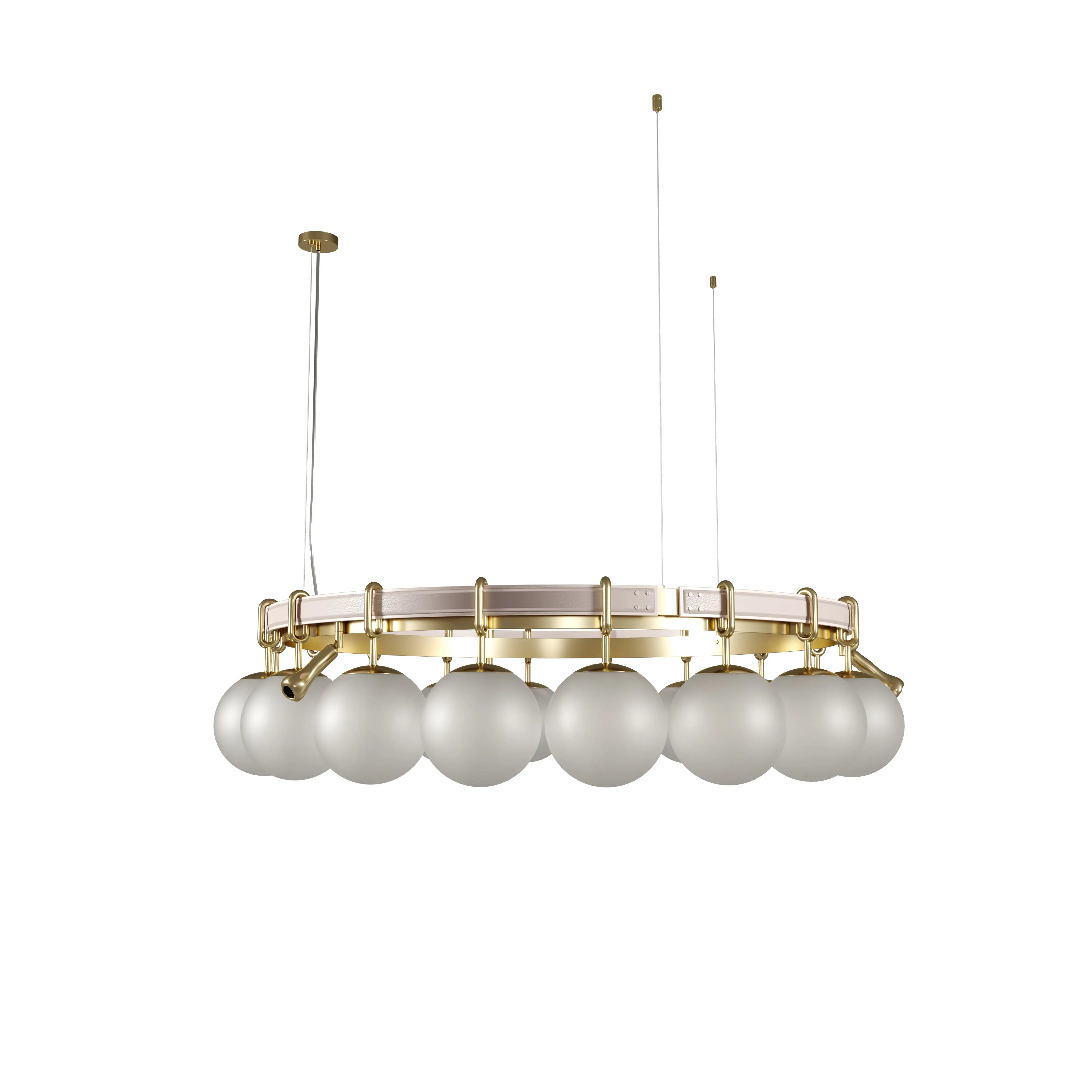
It is the arrangement that keeps most of the advantages of both: the electrical and mechanical parts are proven and available, and the visible part is drawn for the room. The lead time follows the bespoke element only, which is usually the shorter half.
It is worth asking for explicitly, because a supplier quoting from a catalogue will not offer it and a supplier quoting bespoke will price the whole object. The question that opens it is narrow: which parts of this fitting can stay standard?
Tooling, and who owns it afterwards
Some bespoke shapes need a mould, a die or a jig, and that object exists after the order is finished. Who paid for it and who keeps it are two separate questions, and specifications almost never address either.
It matters at the moment a spare is needed. If the tooling was amortised into the unit price and remains with the maker, a single replacement is straightforward; if it was charged separately and then scrapped, the replacement means paying for it again.
One sentence settles it: whether tooling is retained, for how long, and at whose cost. It changes nothing about the first order and everything about the third year.
The drawing belongs to somebody, and phase two finds out
A bespoke fitting is designed by somebody — sometimes the practice, sometimes the manufacturer, often both in stages. Nothing goes wrong while the relationship lasts, and the question arrives when the second phase is tendered to a different supplier.
At that point, whether the drawing can be handed over decides whether phase two matches phase one. It is a commercial matter and not a technical one, and it is far easier to agree at the start than to negotiate under time pressure.

The practical middle ground is common: the maker keeps the process and the client keeps the right to have the piece remade. Neither party loses anything, and the building stays consistent.
What a workshop can and cannot do
Bespoke is not unlimited, and a supplier who says yes to everything is describing a hope. Real constraints are specific and easy to state: the maximum size the kiln or the bath accepts, the thicknesses a material tolerates, the joins a structure needs to stay rigid.
Those constraints are useful early, because they shape the drawing rather than reject it. A piece designed within them arrives on time; a piece designed against them arrives late or arrives compromised.
So the productive first conversation is not «can you make this?» but «what are your limits?». The answer is short, it is factual, and it makes every subsequent decision faster.
The second phase of the hotel is the real test
A supply is easy to judge on delivery and honest to judge two years later, when a floor is refurbished, a fitting breaks, or the owner decides to extend the same language into a new wing.
That is when the difference between a catalogue piece and a made piece stops being about price. A catalogue model may have gone; a made piece exists as long as the drawing and the process exist, and can be produced in twos and threes rather than in batches.
It is worth asking any supplier for an example: a project they supplied years ago and have since supplied again. The answer is either concrete or evasive, and both are informative.

Where a catalogue piece is genuinely better
There are cases where bespoke is the wrong answer and it would be dishonest to pretend otherwise. Anything with a certification burden — emergency units, high ingress protection, hazardous areas — is better bought as a standard product with its testing already done.
The same is true where quantity is large and visibility is low: a hundred identical downlights in back-of-house corridors gain nothing from being drawn, and lose availability by being special.
The useful rule is to spend the bespoke budget where the fitting is seen and where the room is specific, and to buy standard everywhere else. A project that draws everything is not more considered; it is slower and harder to maintain.
The prototype that is worth paying for, and the one that is not
On a shape a workshop has made before, a full prototype adds little: the process is known and a finish sample answers the only open question. On a shape nobody has made, the prototype is not an extra — it is the point at which the design becomes buildable.
The distinction is easy to make and rarely made, because both are called the same thing in a quotation. Asking which of the two is being offered turns a line item into information.
Where a prototype is genuinely needed, it is worth ordering it as its own small contract, with its own date, ahead of the main order. Bundled into the supply it becomes the reason the whole delivery is late; separated, it is a week that protects the rest.
In short
- Custom luminaires eliminate site compromises by matching precise architectural dimensions and structural mounting interfaces.
- Bespoke manufacturing becomes cost-effective at lower volume thresholds than typically assumed when factoring in modification surcharges.
- Early technical coordination between designers and manufacturers prevents costly late-stage structural and electrical retrofits.
- Clear specifications built around validated physical samples ensure finish consistency across all interior FF&E elements.
A project under way?
Upload the specification or configure the rooms: the bill of quantities comes back with fittings and quantities, ready for your next meeting.
Open the advisor